
Budget Friendly Coding Courses for Career Changing Adults
Sifting through online learning platforms gets exhausting when aggressive marketing campaigns push fifteen-thousand-dollar promises. When you manage rent, family routines, or car payments, you cannot simply drop everything to attend a full-time, in-person campus. You need flexible training that respects your existing schedule while delivering actual engineering skills.
Practical programs focus heavily on building projects from scratch rather than forcing you to memorize abstract trivia. Look for platforms that integrate version control, local developer environments, and active discussion forums. When you run into a confusing error at ten at night, having access to an active community on Discord or Discourse makes all the difference between pushing forward and giving up.
Look for strong curriculum depth that forces you to build standalone portfolio applications rather than spoon-feeding you pre-written snippets. The right course challenges your problem-solving abilities without draining your bank balance.
The Odin Project for Self-Paced Full Stack Mastery
The Odin Project stands as the absolute gold standard for free, open-source software education. It guides you through a meticulously curated path covering command line fundamentals, Git, HTML, CSS, JavaScript, and your choice of full-stack Node.js or Ruby on Rails. Instead of keeping you trapped inside a web browser, it teaches you how to install and configure real tools on your own computer.
This platform works best for independent, self-motivated learners who want to understand how software developers actually work on production teams. You build meaningful portfolio pieces, including calculator apps, interactive dashboards, and complete social media clones.
The main trade-off is the complete lack of hand-holding. You must read real technical documentation, search for error codes, and solve tricky bugs on your own. That struggle builds genuine grit, but it can feel overwhelming if you crave constant verbal instruction.
Mastering a local development environment through their curriculum ensures you feel completely comfortable using real engineering terminals from day one.

FreeCodeCamp for Structured Interactive Practice
Browser-based coding challenges give beginners immediate gratification, and FreeCodeCamp built a massive educational ecosystem around that feedback loop. Their platform splits full-stack web development into distinct certification tracks covering responsive design, front-end libraries, relational databases, and data structures.
This platform fits busy adults who only have twenty or thirty minutes to study during lunch breaks or before the morning commute. The bite-sized lessons make it remarkably easy to build a consistent daily habit without feeling intimidated by massive textbook readings.
The browser sandbox is also its biggest weakness. Passing automated unit tests inside a web window does not prepare you for setting up local compilers or fixing complex dependency conflicts. You must actively push yourself to build projects outside their sandbox to solidify the concepts.
Their instant interactive feedback keeps your momentum high during those initial weeks when syntax errors feel like a foreign language.
Scrimba for Interactive Screencasts and Modern Web Skills
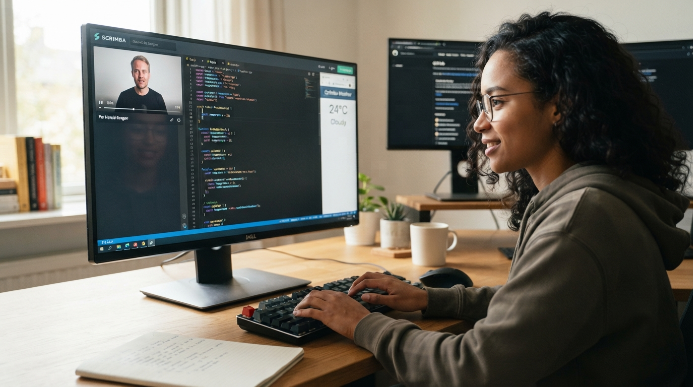
Watching conventional video tutorials often leads to passive watching and zoning out, which is where Scrimba completely flips the learning model. Their custom video player doubles as an active code editor. You can pause the teacher at any second, jump into the actual video code, alter variables, run tests, and watch the output update instantly on screen.
This platform is a fantastic match for visual learners who want to master modern JavaScript, React, and UI styling without reading walls of dry text. The Frontend Developer Career Path offers hundreds of interactive challenges that simulate real workplace assignments.
The downside comes down to the pricing model for advanced modules. While the introductory courses cost nothing, the full career roadmap requires a recurring monthly subscription. It costs a fraction of traditional school, but the cost still requires careful budgeting if your study timeline stretches over a year.
Their unique pause-and-edit screencasts bridge the gap between watching an instructor and writing functional code yourself.
Coursera and Meta Certificates for Structured Academic Milestones
Structured deadlines keep many people accountable, making university-backed and corporate-sponsored certificate tracks on Coursera remarkably effective. The Meta Front-End and Back-End Developer Professional Certificates provide structured weekly modules, graded quizzes, and guided capstone projects created directly by industry staff.
This option shines for career switchers who need rigid deadlines, graded milestones, and a recognizable certificate to showcase on LinkedIn. The coursework breaks complex programming principles into manageable weekly assignments that prevent you from falling behind.
Peer grading represents the biggest frustration here. Waiting for classmates to grade your final assignments can stall your progress, and feedback quality varies wildly. You also pay a recurring monthly fee until you complete all required courses in the series.
Completing their rigorous peer-reviewed capstones provides you with structured code samples that prove your competence to prospective hiring managers.
Udemy Top-Rated Bootcamps for Comprehensive Deep Dives
Grabbing a sixty-hour comprehensive development course on Udemy during one of their frequent sales feels like an unbelievable bargain. Renowned instructors like Colt Steele and Jonas Schmedtmann produce massive, highly detailed courses that cover full-stack development from basic syntax to cloud deployment.
These comprehensive packages work wonderfully for budget-minded adults who want lifelong access to one massive training resource without ongoing subscription anxiety. You can revisit complex lessons months down the road whenever you need a quick refresher.
The biggest drawback is the complete absence of external accountability. Because these courses frequently sell for under twenty dollars, thousands of students buy them on impulse and abandon them before reaching intermediate topics. You must supply your own discipline to finish the material.
Taking advantage of their lifetime access model allows you to revisit intricate database and API lectures whenever you need a quick reference.

Harvard CS50x for Foundational Computer Science Logic
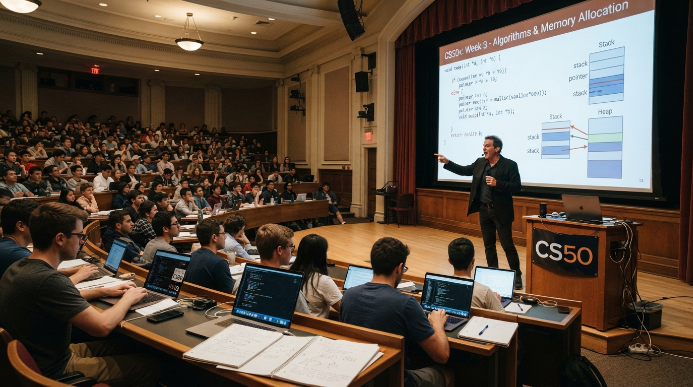
Most entry-level boot camps skip foundational computing principles to rush straight into basic styling, but Harvard University’s free CS50x course takes the opposite approach. Professor David Malan leads you through memory allocation, data structures, algorithms, and fundamental programming logic using C, Python, SQL, and JavaScript.
This course is ideal for career switchers who want to understand how computers execute code under the hood rather than just pasting pre-made framework components. Grasping these fundamentals makes learning any future programming language significantly faster.
Be prepared for exceptionally difficult homework assignments. The problem sets demand intense logical reasoning and hours of debugging. If you struggle with math anxiety or get frustrated easily by cryptic compiler warnings, this course will test your patience.
Developing sharp algorithmic thinking early in your journey prevents you from hitting a cognitive ceiling when you tackle advanced software architecture later.
How Career Changers Can Protect Their Study Routine
Balancing a forty-hour workweek with late-night syntax drills requires realistic expectations and strict boundary management. Trying to study for eight hours every Saturday almost always leads to burnout, mental fatigue, and abandoned goals. You will make far more progress by dedicating forty-five focused minutes every single evening.
Treat your learning sessions like non-negotiable appointments on your calendar. Close distracting social tabs, put your phone in another room, and focus on one specific concept per session. Joining developer communities on Discord or Reddit also gives you a place to vent, celebrate small wins, and ask questions when code fails to run.
Choosing budget friendly coding courses for career changing adults gives you the financial freedom to learn without panic. When you remove massive tuition debt from the equation, you can focus entirely on writing clean code and building an impressive portfolio.
Relying on consistent micro-learning blocks keeps your brain engaged without interfering with your existing professional and family obligations.
Frequently Asked Questions
Can budget friendly coding courses for career changing adults actually lead to a job?
Yes, hiring managers in software care far more about your portfolio projects, problem-solving skills, and code quality than the price tag of your education. Building complex, original applications proves your practical abilities much better than simply showing an expensive paper diploma.
How many hours per week should I study while working full-time?
Aim for ten to fifteen hours per week. Squeezing in one to two focused hours on weeknights and a longer block on the weekend maintains steady momentum without causing severe mental burnout or disrupting family life.
Which programming language should I learn first as a career switcher?
JavaScript or Python offer the smoothest entry points. JavaScript powers all modern interactive websites and web applications, making it essential for front-end roles. Python features clean, readable syntax that simplifies learning programming logic, data automation, and back-end development.
Are cheap coding courses updated frequently enough for the current job market?
Top platforms update their flagship materials regularly to reflect modern industry standards. Instructors on platforms like Scrimba, Udemy, and The Odin Project regularly revise modules to teach modern syntax, current framework versions, and modern developer tooling.
Do I need a computer science degree to get hired as a junior developer?
No, the tech industry regularly hires self-taught engineers and career switchers who demonstrate strong technical competence. You must build a clean GitHub profile, deploy live full-stack web applications, and clearly explain your technical decisions during coding interviews.
Conclusion
Pivoting into tech is entirely possible without taking on thousands of dollars in high-interest educational debt. Pick one reputable program from this list, commit to a manageable daily study routine, and start writing your first lines of code tonight. Which coding path aligns best with your current career goals?
